An activewear tech pack is the buyer-controlled specification set that explains what a factory should develop, measure, source, decorate, and prepare for production. Before a factory starts pattern and sample development, send enough information to connect the design brief to the pattern, sample, and eventual bulk-production specification.
At minimum, the request package should identify the style, garment category, intended wearer, technical sketch, construction details, base measurements, fabric and trims, colors, branding, packaging, target market, and shipment requirements. The more clearly these inputs are separated and labeled, the less the development team must infer during feasibility review, quotation alignment, and sampling.
What an Activewear Tech Pack Should Include Before Development
A complete activewear tech pack does not need to answer every development question on day one, but it should make decisions, open questions, and approval status visible. The basic workflow is:
Tech pack → pattern development → sample → fit and construction review → approved production specification.
Ninghow Yoga reviews product requirements, materials, patterns, samples, branding, and bulk-production readiness against buyer-controlled specifications. Missing information can delay feasibility conclusions or create clarification loops, so use the following as a first-pass package structure.
| Information area | What to include | Why it matters before development |
|---|---|---|
| Style identity | Style name or ID, product category, intended wearer, season, and reference images | Helps the team identify the product and separate inspiration from approved instructions |
| Design and construction | Technical sketch, seam lines, panels, waistband, straps, closures, pockets, lining, and edge finishes | Supports feasibility review and initial pattern interpretation |
| Materials and trims | Fabric direction, composition, weight or hand-feel reference, stretch direction, elastic, thread, zipper, cups, labels, and hangtags | Allows sourcing and construction decisions to be evaluated together |
| Measurements and fit | Point-of-measure chart, units, base size, size range, grading direction, tolerances, and fit priorities | Provides the basis for pattern work and sample measurement review |
| Branding and packaging | Artwork, decoration method, logo placement, labels, care content, hangtags, folding, and packaging presentation | Prevents branding and order-preparation details from being overlooked |
| Commercial and logistics | Target market, quantity direction, required shipment information, and unresolved decisions | Helps align quotation, order preparation, and production handoff |
Pre-submission checklist:
- Each garment has its own style name, sketch, measurements, and construction notes.
- Inspiration images are separated from approved technical instructions.
- Every measurement has a point of measure and measuring method.
- Fabric, trims, color references, and performance expectations are identified or clearly marked open.
- Artwork files, logo placement, label instructions, and packaging requirements are attached or listed.
- Target market and shipment requirements are included where they affect preparation.
- Open decisions are labeled with an owner and approval status rather than left implicit.
Start With an Activewear Technical Sketch and Construction Notes
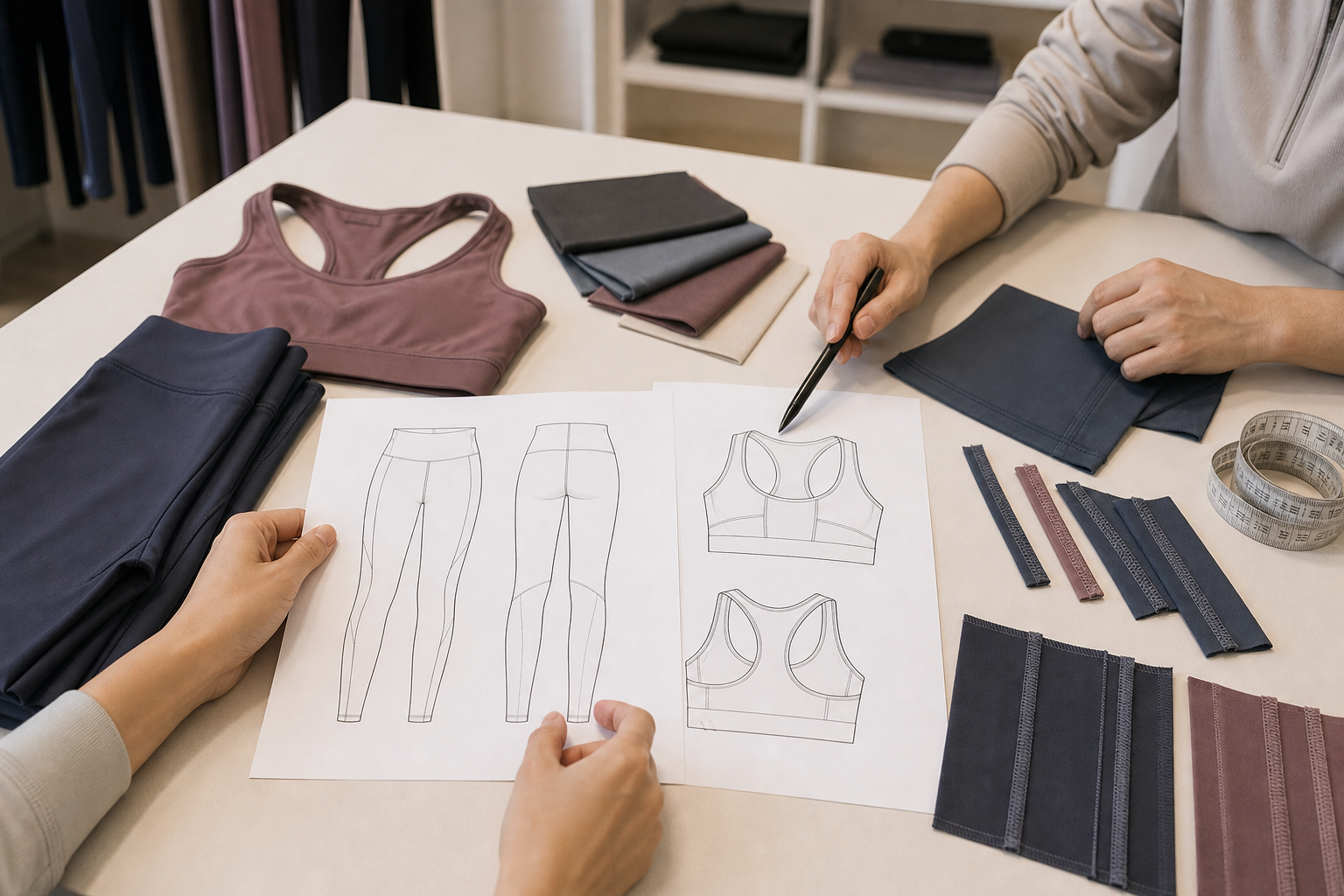
An activewear technical sketch, or technical flat, gives the factory a neutral view of the garment without the distractions of a styled photograph. For leggings, bras, tops, jackets, shorts, and sets, provide front and back views plus detail views where construction cannot be understood from the main sketch.
Call out the design features that affect pattern shape, sewing, fit, or wear. These may include panel joins, gussets, waistband height, pocket openings, strap width, neckline, closures, lining, removable cups, internal support, compression zones, zipper behavior, reflective details, and edge finishes. If a seam type or finish is not decided, identify it as an open development question instead of allowing the team to assume.
| Technical sketch callout | Instruction to provide | Example of a useful clarification |
|---|---|---|
| Waistband | Height, number of layers, elastic construction, drawcord, and finish | State whether the waistband is intended to sit high, fold, compress, or remain smooth during movement |
| Seams and panels | Panel boundaries, seam type if known, reinforcement, and visual priority | Identify whether a seam is functional, decorative, or required for shaping |
| Support areas | Lining, cups, internal layers, elastic, or support zones | Explain the intended support level and whether removable cups are required |
| Pockets and closures | Opening position, size, access direction, zipper or hook details | Mark the fixed garment reference point used for placement |
| Edges and openings | Binding, elastic, coverstitch, raw edge, hem, cuff, or folded finish | Note the desired appearance and whether stretch must be preserved |
Keep inspiration photos in a separate reference section. A photo can communicate mood, silhouette, or styling, but it should not silently replace a technical instruction. For coordinated sets, specify the bra, top, leggings, or shorts separately. A set may share a fabric or color strategy, but each garment needs its own construction and measurement requirements.
The following is an illustrative callout structure, not a redacted customer or factory document: View: front flat; Callout: side seam; Instruction: confirm panel angle and seam finish; Status: open for development review. This format makes uncertainty visible without treating a sketch as complete by default.
Build a Garment Measurement Chart That Defines Fit
A garment measurement chart gives the pattern and sample teams a measurable fit target. It should state the unit system, base size, graded size range if available, measuring method, and any buyer-defined tolerances. A visual approval alone does not confirm fit performance.
Use fixed points of measure that can be repeated on the pattern and sample. For fitted yoga leggings, buyers commonly need to address waistband, waist, hip, rise, inseam, outseam, leg opening, gusset, and body coverage. The exact list depends on the product and the intended silhouette. Include fit priorities such as mobility, strap placement, rise, compression preference, and coverage rather than relying only on a front and back image.
Illustrative measurement-chart template — enter buyer-approved values before submission:
| Point of measure | Measurement method | Base size | Tolerance | Approval status |
|---|---|---|---|---|
| Waistband height | Measure vertically from the top edge to the lower edge; state whether relaxed or extended | Enter buyer base size | Enter buyer-defined tolerance | Draft / buyer review / approved |
| Waist circumference | Measure around the finished garment at the specified waistband position | Enter buyer base size | Enter buyer-defined tolerance | Draft / buyer review / approved |
| Hip circumference | Measure around the garment at the defined hip level without stretching unless stated | Enter buyer base size | Enter buyer-defined tolerance | Draft / buyer review / approved |
| Front rise | Measure from the crotch intersection to the top front waistband edge | Enter buyer base size | Enter buyer-defined tolerance | Draft / buyer review / approved |
| Back rise | Measure from the crotch intersection to the top back waistband edge | Enter buyer base size | Enter buyer-defined tolerance | Draft / buyer review / approved |
| Inseam | Measure from the crotch intersection to the finished leg opening | Enter buyer base size | Enter buyer-defined tolerance | Draft / buyer review / approved |
| Leg opening | Measure around the finished opening; state relaxed or extended condition | Enter buyer base size | Enter buyer-defined tolerance | Draft / buyer review / approved |
Measurement comments should also explain how the garment is presented for review: laid flat, relaxed, unstretched, or fully extended. For maternity or extended-size styles, request dedicated grading and fit validation. Maternity designs may require specific waistband, growth allowance, coverage, mobility, and safety review rather than simple extension from a standard block. Brands preparing a size range can also use activewear fit development support to clarify how measurements and sample comments will be reviewed.

Specify Fabric, Stretch, Recovery, and Trim Requirements
A fabric name or attractive swatch is not a complete material specification. State the preferred composition, weight or hand-feel reference, stretch direction, recovery expectation, finish, and color when known. For fitted activewear, explain whether the priority is smooth coverage, stable support, flexible mobility, or softer drape.
Nylon/elastane interlock may be considered for leggings, bras, shorts, fitted tops, and coordinated sets because dense interlock can offer a smooth hand, coverage, and multidirectional stretch. However, the approved weight, gauge, elastane content, finish, and recovery should govern the product. Do not infer opacity, moisture management, cooling, or compression from composition or weight alone. These are confirmation items for material review and sample evaluation.
List components individually in the tech pack:
- Shell fabric and any contrast fabric
- Waistband or leg elastic
- Thread and seam construction requirements
- Zippers, hooks, drawcords, and cord ends
- Lining, bra cups, mesh, or internal support layers
- Main labels, care labels, size labels, hangtags, and packaging components
Describe the intended activity and wear conditions. For leggings, review waistband stability, stretch recovery, opacity, gusset shape, and seam placement as a system. For bras, support depends on the complete construction system rather than one fabric feature. A useful fabric and trim sourcing brief helps the development team compare materials against the actual garment requirements.
Document Branding, Color, Labels, and Artwork Placement
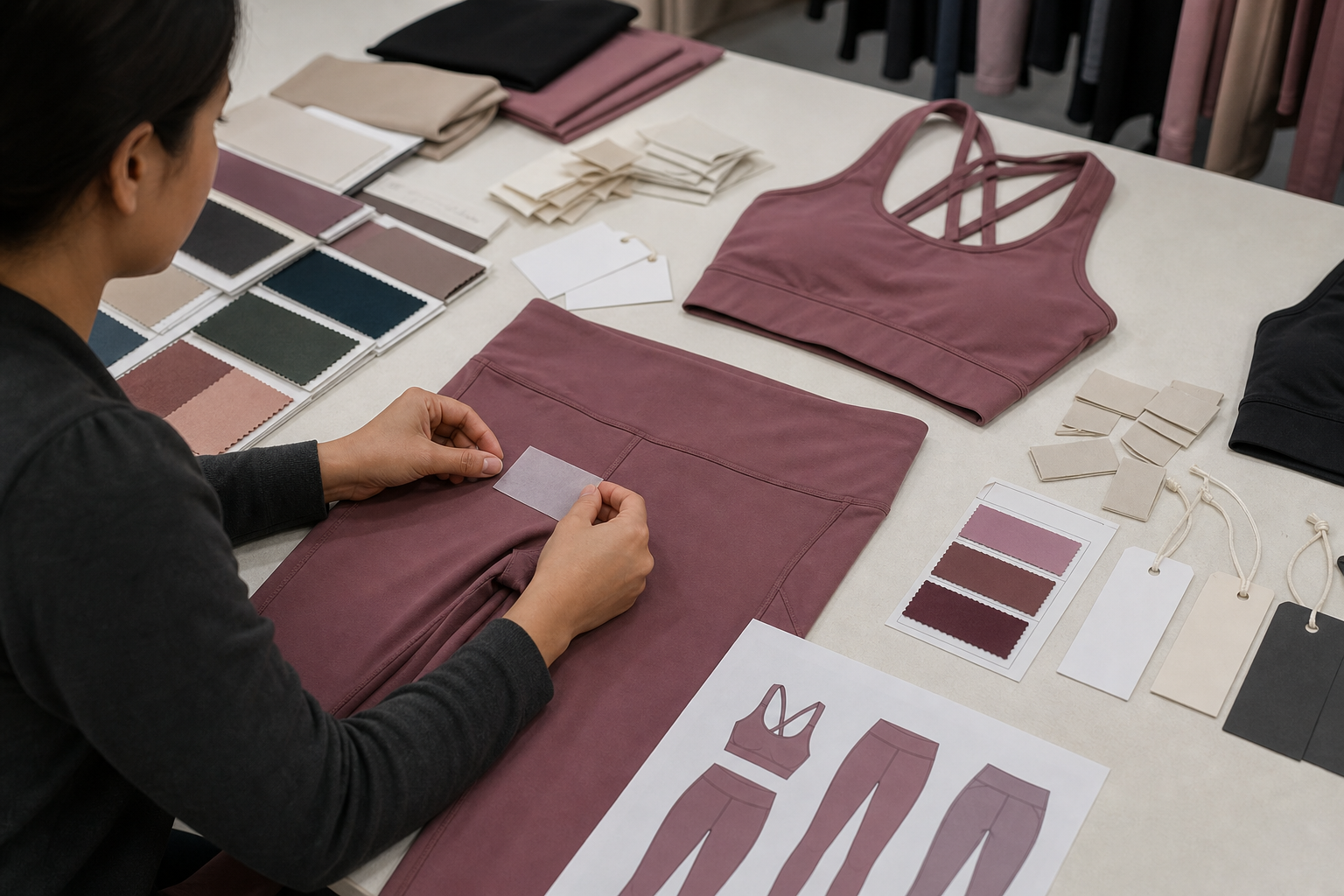
Branding instructions should be precise enough to reproduce and separate from the garment pattern. Provide editable artwork where available, identify the intended decoration method if already selected, and specify whether color matching is required across a coordinated set.
- Mark logo size and placement from fixed garment reference points such as the center front, waistband edge, side seam, or hem.
- Identify whether the mark is printed, transferred, embroidered, woven, molded, or still under review.
- Attach approved color references and state whether shades must match across different fabrics or garments.
- Provide label dimensions, content, position, folding requirements, and care-content instructions.
- List hangtag, folding, polybag, carton, and other packaging presentation requirements separately from pattern instructions.
Private-label manufacturing requires coordination of labels, hangtags, colors, branding, packaging, and collection presentation. A coordinated bra and legging set may need consistent shade and logo placement, but each garment still needs its own artwork reference. For decoration questions, distinguish placement approval from final performance approval and review the intended method through activewear logo application planning.
Review the Tech Pack for Feasibility Before Pattern and Sample Development
Before sending the package, compare every sketch callout with the measurement chart, material list, trim list, artwork file, and written notes. A missing link between two files is often where clarification begins.
Ninghow Yoga’s quality-control sequence is structured around product-requirement review, fabric and color checking, measurement and sewing inspection, process quality control, final inspection, and packaging review. For a buyer, this means the handoff should make each later review possible rather than leaving key decisions only in a conversation.
- Requirement review: confirm style identity, target market, shipment needs, and open decisions.
- Material and color review: confirm fabric direction, trims, shade strategy, and performance items requiring validation.
- Measurement and sewing review: compare sample measurements and construction with the approved specification.
- Process review: identify changes that affect repeatability or bulk-production readiness.
- Final and packaging review: confirm approved branding, garment presentation, labels, and order-preparation requirements.
Use revision control so the factory and buyer do not work from different files. The following is a clearly labeled illustrative template, not a first-party production record:
| Version | Revision | Date | Change | Approval status |
|---|---|---|---|---|
| Enter version | Enter revision | YYYY-MM-DD | Initial style direction, sketch, and specification package | Draft — buyer review |
| Enter version | Enter revision | YYYY-MM-DD | Updated measurements, construction notes, or fabric direction | Pending feasibility review |
| Enter version | Enter revision | YYYY-MM-DD | Recorded sample comments and approved changes | Approved for next sample |
| Enter version | Enter revision | YYYY-MM-DD | Locked production specification and packaging instructions | Approved for bulk preparation |
Buyer Decision Framework: What to Send First, What Can Follow, and What Must Be Finalized
Not every detail has to be fully closed before an initial enquiry, but the buyer should show which decisions are firm and which are open. Use this framework to prioritize the information that most affects pattern work and feasibility.
| Timing | Details | Why this timing matters | Buyer action |
|---|---|---|---|
| Final before submission | Style direction, garment category, base measurements, key construction requirements, and core brand identity | These decisions define what the factory is being asked to develop | Do not leave them to visual interpretation; attach the approved instruction |
| Preferably final | Fabric direction, trim list, artwork files, color strategy, and packaging instructions that affect development | Changes can affect pattern behavior, sourcing, decoration, or costing alignment | Submit approved choices or clearly flag an accepted alternative |
| Can follow if clearly labeled | Alternate colorways, non-critical decoration options, or secondary packaging details | These may not prevent initial review when the core style is clear | Mark as open, identify the decision owner, and state the approval deadline |
| Always separate by garment | Measurements, construction notes, and artwork for each bra, top, legging, or short | A coordinated set is not one technical product | Use one style section per garment, even when fabric and colors are shared |
The practical trade-off is speed versus rework. Sending a partial package may start a conversation sooner, but it can produce less reliable feasibility or quotation alignment. A cleaner enquiry package gives the development team a stronger basis for evaluating what is possible without guessing missing details.
Common Missing Details That Slow Activewear Development
The most common gaps are not always dramatic design problems. They are small ambiguities that make a pattern, sample, or approval difficult to repeat:
- Unlabeled measurements: a number is provided without a point of measure, base size, measuring condition, or tolerance.
- Inspiration treated as instruction: a reference photo is supplied without an approved technical sketch or construction notes.
- Unstated performance expectations: stretch, recovery, support, opacity, or moisture-management requirements are assumed from fabric appearance.
- Incomplete branding: artwork is missing, logo placement is unclear, or labels and care content are not defined.
- Set-level shorthand: a bra and legging set is described as one product even though the garments have different measurements and construction.
- Visual-only fit approval: the buyer approves appearance without reviewing sample measurements, fit comments, and construction.
Resolve the highest-impact gaps first: fit and base measurements, then fabric and construction, followed by branding and packaging. When a decision cannot yet be finalized, mark it as open rather than allowing an assumption to become part of the pattern. Once the package is organized, you can upload your specifications with a clearer handoff.
Frequently Asked Questions
What is the difference between an activewear tech pack and an apparel specification sheet?
An activewear tech pack is usually a fuller development package that can include sketches, construction notes, measurements, materials, branding, packaging, and revision control. An apparel specification sheet may focus more narrowly on product requirements and measurements. In practice, the terms can overlap, so define the contents and approval status of the files you send.
Can a factory develop an activewear sample from sketches and reference photos?
Sometimes an initial feasibility discussion can begin that way, but sketches and photos alone may not define measurements, construction, materials, or branding. A technical sketch, measurement chart, and written notes provide a more reliable basis for pattern and sample development.
What measurements should be included in a garment measurement chart for yoga leggings?
Depending on the style, include waistband height, waist, hip, front rise, back rise, inseam, outseam, leg opening, gusset dimensions, and other coverage points. State the measuring method, base size, size range, garment condition, tolerance, and approval status.
Should fabric and trim choices be finalized before sending an activewear tech pack?
Core fabric direction and trims should be provided before development when they affect stretch, recovery, support, construction, or decoration. Alternate colors or non-critical packaging details may follow if they are clearly marked open and do not change the core development brief.