
Short answer: Production-ready apparel pattern files are not a loose attachment. They are an approved, traceable package connecting usable pattern data with grading, measurements, construction details, a BOM, and an approved sample reference.
Before bulk manufacturing, a buyer also needs to know whether the receiving factory can open and validate the files, which revision is authorized, and what changes require written approval. If fit or construction is still being refined, begin with a pattern and sample development capability rather than treating an early development file as a production release.
From a custom yoga and activewear manufacturing perspective, this handoff is a procurement decision. The package must be clear enough for pattern review, material preparation, cutting, sewing, finishing, inspection, and packaging. The following questions help buyers close the most common gaps before releasing a style to bulk.
What Makes an Apparel Pattern File Production-Ready?
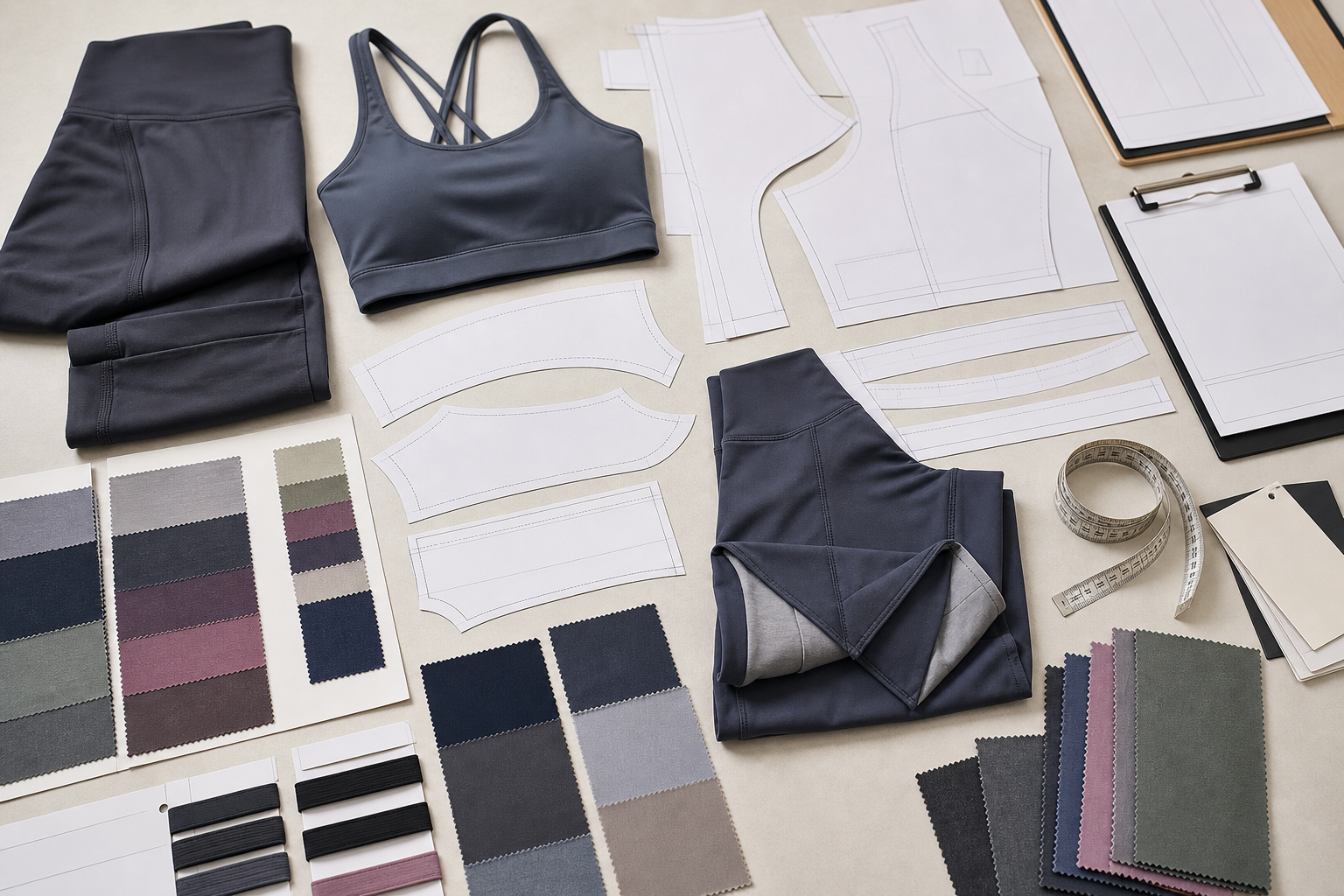
A production-ready handoff combines approved pattern data with the documents and references needed to interpret it. The exact package varies by product and factory workflow, but a buyer normally needs to connect the following items:
- Base pattern: The starting size and style geometry, including piece names and construction intent.
- Graded size set: The approved size range, with grade rules or sufficient information for the manufacturer to review the grading.
- Cutting output or marker: A cutting preparation file where applicable. This may depend on confirmed fabric width, usable width, direction, shrinkage, and yield decisions.
- Tech pack and measurement chart: The dimensional, construction, labeling, decoration, and inspection references used alongside the pattern.
- Bill of Materials: A BOM organizes fabrics, trims, labels, elastics, bindings, thread, packaging components, and other garment parts.
- Approved sample reference: The physical or documented sample that establishes the agreed fit, construction, material, color, branding, and workmanship baseline.
A file can be technically complete and still not be production-ready for a particular manufacturer. The receiving team needs to validate the format, units, layers, annotations, size mapping, and relationship between the pattern and specification package. For OEM development, buyer-controlled specifications remain important, but they still need feasibility review and sampling before production release.
Ask the factory to answer three questions at the first handoff: Can you open and inspect the files? Can you match them to the tech pack and approved sample? What must be corrected or converted before cutting preparation? A clear answer creates a decision gate between development and bulk manufacturing.
Which Apparel Pattern File Formats Can Your Manufacturer Use?
Do not assume that a familiar extension is automatically usable in production. Apparel pattern file formats differ in how much editable geometry, grading data, annotation, and layer information they contain. The same file may be suitable for review but unsuitable for direct manufacturing preparation.
| File type or package | Possible role | Typical limitation to clarify | Question for the manufacturer |
|---|---|---|---|
| Editable CAD export, such as DXF | Pattern geometry, piece information, and sometimes grading or annotation transfer | Import behavior, supported version, units, layers, and grading content may vary by system | Can your system import this export without losing grading, notches, seam allowances, or piece names? |
| Native CAD file | Source editing and detailed pattern development within a specific software environment | The receiving team may not use the same software or native file version | Do you use this native system, or do you need an agreed export for review and production? |
| PDF pattern | Visual review, reference, printing, or measurement comparison | It may be view-only and may not include editable geometry, grade rules, or reliable production metadata | Is this PDF sufficient for your workflow, or do you also need editable pattern data? |
| Adobe Illustrator or artwork file | Artwork, logos, prints, labels, or placement references | Artwork geometry is not necessarily production pattern geometry | Which file contains the actual pattern, and which file is only for decoration or branding? |
This comparison is a buyer discussion tool, not a claim that every factory accepts every format. Ninghow Yoga can review available drawings, sample garments, measurement tables, and BOMs during an inquiry, but the manufacturing team must confirm the usable file type and import information for the specific project.
Include these details in your pattern file handoff questions:
- Which pattern system and export versions can the factory open?
- Are all measurements expressed in the required units and scale?
- Are seam allowances, notches, grain direction, drill points, cut quantities, layers, and piece names visible?
- Does the package include the full size range or only a base size?
- Are artwork files clearly separated from pattern files?
- Will conversion, annotation, or pattern checking be required before sampling or cutting?

How Should You Identify the Correct Pattern Revision?
Pattern revision control prevents a bulk order from using an outdated shape, measurement, fabric reference, or construction instruction. Email attachments and informal image approvals are not a reliable substitute for Document Control.
At minimum, place these fields on the pattern package and related documents:
- Style Code or Style ID
- Version
- Issue Date
- Revision
- Approval Status
- Size Range
- Responsible Owner, where useful
- Sample Stage, such as development, fit review, pre-production, or bulk release
The approved fit sample, graded pattern revision, fabric version, and construction details need to point to the same controlled product version. If one document changes, the related package must be checked rather than silently replaced.
Illustrative revision-control example
This is a blank buyer-side example structure, not a Ninghow Yoga factory record or customer document.
| Version | Revision | Issue date | Change | Approval status |
|---|---|---|---|---|
| V1.0 | R01 | [YYYY-MM-DD] | Initial base pattern issued for fit sample | Pending fit review |
| V1.1 | R02 | [YYYY-MM-DD] | Waistband or inseam changed according to documented sample comments | Pending buyer approval |
| V2.0 | R03 | [YYYY-MM-DD] | Graded size set updated and linked to the approved tech pack and BOM | Released for bulk only after written approval |
Before bulk release, ask: Which revision is final? Which sample approved it? What changed from the previous version? If the factory finds a mismatch between the pattern, measurement specification, sample, and production instructions, the discrepancy needs to stop the release long enough for the buyer and factory to agree on the controlling version.
What Questions Should You Ask About Grading, Fit, and Construction?
A base-size pattern does not prove that a style is ready across the full size range. Ask for the approved base size, graded sizes, measurement tolerances, grade rules, and size-system assumptions. Also clarify whether the measurement chart describes body measurements, garment measurements, or both.
Illustrative measurement-chart template
Use this as a buyer template. It contains no Ninghow Yoga measurement values.
| Point of measure | Measurement method | Base size | Tolerance | Approval status |
|---|---|---|---|---|
| [Example: waistband circumference] | [Flat or circumference; state position and tension] | [Buyer base size] | [Buyer tolerance] | [Pending / approved / revise] |
| [Example: inseam length] | [From defined seam intersection to hem] | [Buyer base size] | [Buyer tolerance] | [Pending / approved / revise] |
| [Example: bust or body length] | [State landmarks, garment position, and measurement condition] | [Buyer base size] | [Buyer tolerance] | [Pending / approved / revise] |
For leggings, sports bras, and fitted yoga tops, pattern interpretation also depends on the selected fabric and construction. Discuss composition, weight, usable width, stretch and recovery, shrinkage, opacity, seam type, elastic, binding, and intended ease or compression before finalizing the pattern. These are review and testing topics, not universal performance promises.
Request confirmation that the pattern includes or clearly references:
- Grain direction or fabric direction
- Cut quantities and mirrored pieces
- Seam allowances and hem treatments
- Notches, drill points, balance marks, and piece names
- Gusset, waistband, elastic, binding, lining, or support construction where applicable
- Decoration and artwork placement with measurable positioning references
Ninghow Yoga supports sizing, fit, measurement review, sample coordination, and fit communication before bulk production. Staged samples are useful because construction, measurements, fit, material, color, branding, and production readiness may need separate approval. A visual approval alone does not automatically approve fit, performance, or bulk materials.
Who Owns the Pattern Files and What May Be Changed?
Ownership and change control are practical production questions, but they are also contract questions. This article is not legal advice; the applicable terms belong in the buyer’s supplier agreement and should be reviewed by the buyer’s adviser.
Before sending files, ask the manufacturing partner to clarify:
- Who owns buyer-supplied patterns, manufacturer-created revisions, graded versions, markers, and development records?
- May the factory adjust a pattern for fabric behavior, shrinkage, machinery, yield, seam construction, or production feasibility?
- Which changes require written buyer approval before sampling or bulk?
- How will revised files be issued, named, stored, and linked to the approved sample?
- What confidentiality and reuse restrictions apply to the style and its related files?
Some production adjustments may be technically sensible, but a silent change after sample approval can alter fit, appearance, yield, or workmanship. Align on permitted changes before the handoff, then record material revisions through the agreed approval route. For repeat orders, controlled specifications, approved versions, material availability, color references, packaging files, and demand planning all support continuity.
Use This Pattern File Handoff Checklist Before Bulk Manufacturing
Use the checklist below as a pre-bulk decision gate. A complete package does not remove the need for a factory review; it gives the review a clear baseline.
- Style identity: Style Code or Style ID, product name, size range, season or collection, and responsible owner.
- Final pattern data: Base pattern, graded size set, required editable files, and cutting output or marker information where applicable.
- Compatibility: Factory-confirmed file format, software or import route, units, scale, layers, annotations, and conversion requirements.
- Revision control: Version, revision, issue date, change summary, sample stage, and approval status.
- Measurement chart: Points of measure, methods, base size, grade rules or size mapping, tolerances, and approval status.
- Tech pack: Construction details, seam and hem instructions, stitch or finishing requirements, labeling, packaging, and inspection references.
- BOM: Main fabric, lining, elastic, binding, trims, labels, thread, decoration materials, and packaging components.
- Material alignment: Confirmed fabric reference plus relevant review of width, stretch and recovery, shrinkage, opacity, color, and finish.
- Artwork placement: Measurable placement instructions, artwork file separation, decoration method for review, and approval reference.
- Approved sample: Sample identity, fit comments, construction comments, material and color approval, and the revision connected to that sample.
- Change authority: Written agreement on who may modify the pattern and how changes receive approval.
- Pre-bulk decision: Ask whether a pre-production confirmation sample or final measurement review is recommended before cutting bulk.
Illustrative handoff map
This is a labeled planning example, not a redacted first-party document or actual factory record.
| Handoff element | What it controls | What the buyer and manufacturer compare |
|---|---|---|
| Pattern files and grading | Shape, piece geometry, size range, and cut intent | File compatibility, annotations, size mapping, and revision |
| Tech pack and construction details | Assembly, finishing, branding, and workmanship expectations | Pattern pieces, sample construction, and production instructions |
| Measurement chart | Garment dimensions, tolerances, and fit checkpoints | Approved sample measurements and graded size measurements |
| BOM and material references | Fabrics, trims, labels, elastics, and packaging components | Sample materials, bulk materials, color references, and availability |
| Approved sample | Physical reference for fit, appearance, construction, and finish | Controlled documents before release to cutting and sewing |
Once the handoff package matches the approved sample and controlled specifications, the manufacturing team can coordinate the downstream sequence. Ninghow Yoga’s stated production scope includes material preparation, cutting and sewing, finishing, inspection, and packaging, although not every order uses every process in the same way. For broader coordination, buyers can review the OEM apparel manufacturing process.
If you are preparing a new style, send the pattern package together with the measurement chart, BOM, tech pack, sample status, and specific compatibility questions. The contact the manufacturing team route is the appropriate next step for confirming what the factory can review before bulk release.
FAQ
Is a PDF pattern sufficient for apparel bulk manufacturing?
Usually, a PDF is best treated as a review or reference file unless the manufacturer explicitly confirms that it contains everything required for its workflow. Ask whether editable pattern data, grading, seam allowances, notches, units, and production annotations are also needed.
What is the difference between a base pattern, graded pattern, and production marker?
A base pattern represents one starting size. A graded pattern includes the size range created from that base. A production marker arranges pattern pieces for cutting and may depend on confirmed fabric width, direction, shrinkage, and yield decisions.
Can a manufacturer change my apparel pattern before bulk production?
Potentially, but the permitted changes and approval route need to be agreed in advance. Any change that affects fit, measurements, construction, material behavior, appearance, or yield should be documented and linked to a new controlled revision before bulk production.
Should I send pattern files before or after approving the final sample?
Send early files for compatibility and feasibility review, but release the bulk version only after the final sample, measurements, materials, construction details, and revision status are aligned and approved.