Choosing a US vs overseas private label yoga apparel manufacturer is not a simple choice between “local” and “lower cost.” A US-based partner can suit brands that need closer domestic coordination or frequent in-person access, while an overseas partner can suit teams seeking broader sourcing options and coordinated development-to-shipment support. The better route depends on your product readiness, internal sourcing capacity, labeling obligations, launch plan, and total landed cost.
Location alone does not determine quality, speed, or project fit. For either route, a brand needs a documented brief, clear sample approvals, controlled revisions, and a practical division of responsibilities. Brands looking for a guided process can start by reviewing private-label yoga apparel manufacturing requirements before requesting comparable quotes.
US-Based vs. Overseas Private Label Yoga Apparel Manufacturers: The Short Answer
A private label activewear manufacturer USA may be a practical fit when domestic communication, local warehousing, or regular in-person collaboration matters more than expanding the sourcing search. An overseas yoga clothing manufacturer may fit a buyer that can manage cross-border decisions—or wants a supplier to coordinate sourcing, sampling, branding, quality steps, packaging, and shipment preparation within a structured workflow.
Use the same inputs for every supplier. A quote without the same garment specifications, materials, labels, packaging, delivery term, and quantity is not a reliable comparison.
| Decision area | US-based route may fit when | Overseas route may fit when | What to compare |
|---|---|---|---|
| Development communication | Your team needs substantial real-time collaboration or site access. | You can work to an agreed feedback cadence and documented approval gates. | Named contacts, time-zone coverage, revision process, escalation path. |
| Product coordination | The supplier’s local capability matches your required garments and processes. | The supplier can demonstrate a suitable product route and coordinated sourcing. | Category experience, sample workflow, fit system, material and trim options. |
| Logistics | Domestic delivery and local inventory flow are central to the launch plan. | Your brand can own, or has support for, import and international freight decisions. | Pickup, export, freight, insurance, import, brokerage, final delivery. |
| Budget | The complete domestic cost model fits the program. | The complete landed-cost model fits after freight, duties, brokerage, and handling. | Like-for-like quote worksheet—not unit price alone. |
| Labeling and compliance | You need close coordination on market-ready labels and packaging. | You can provide clear destination-market requirements early. | Care labels, fiber content, country-of-origin marking, hangtags, packaging files. |
Buyer comparison checklist: Before ranking either route, collect the supplier’s development workflow, responsibility matrix, current quote assumptions, production checkpoints, packaging specification, shipment term, and list of buyer-supplied labeling information. This is an illustrative buyer worksheet, not a factory quote or performance record.
Compare Development Communication and Hands-On Support
The key question is not simply how quickly a supplier replies. It is who owns each development decision and how a change becomes an approved production instruction. First collections, compression-sensitive leggings, supportive bras, seamless styles, and multi-piece sets typically need more disciplined interaction because fit, construction, fabric behavior, and branding details can affect one another.
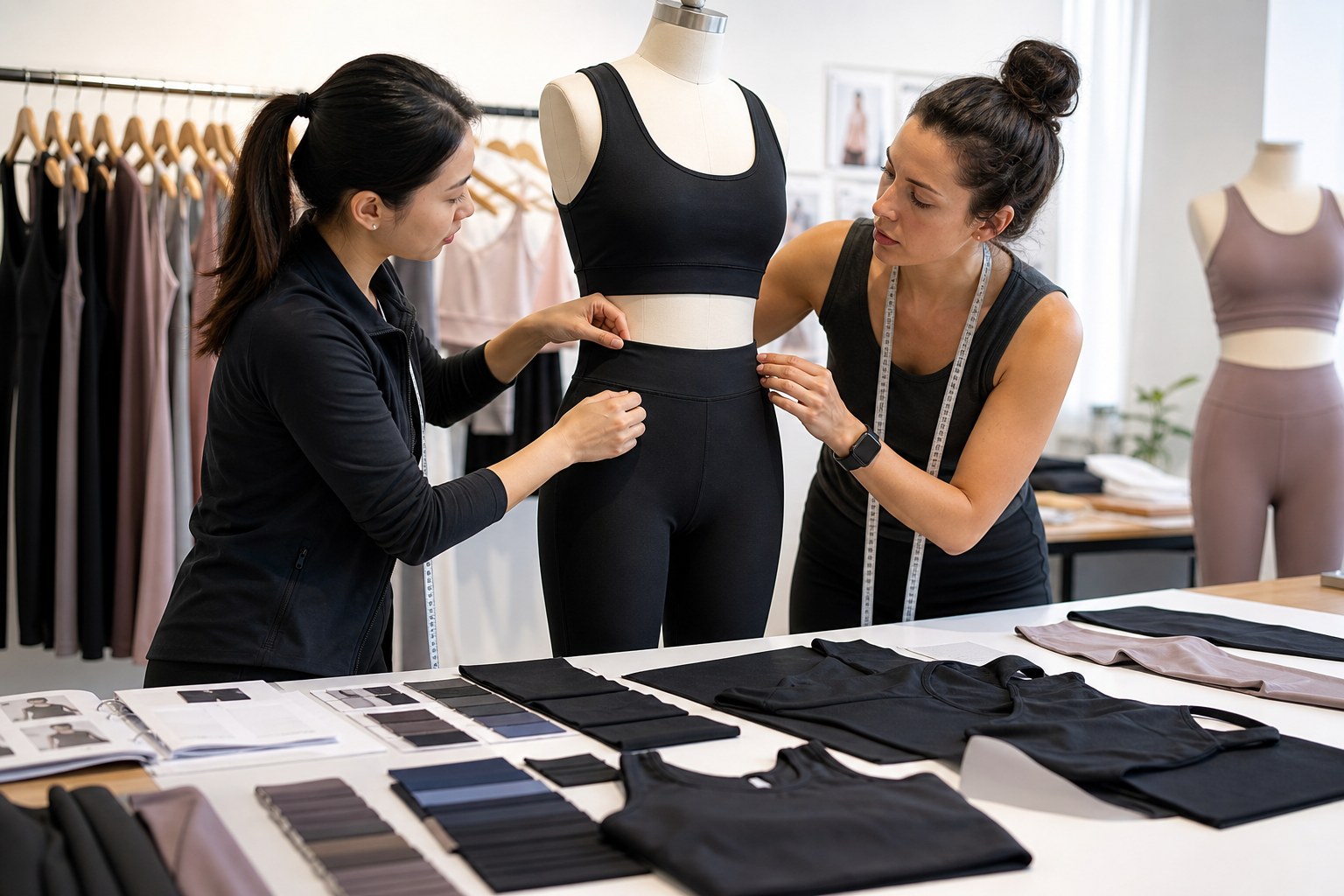
A capable workflow moves from a design brief or tech pack through material direction, pattern work, samples, fit comments, corrected samples where required, and bulk-production handoff. Staged samples allow the buyer to assess construction, measurements, fit, material, color, branding, and production readiness. A visual approval by itself does not necessarily approve fit, performance, or the materials intended for bulk.
| Development responsibility | Buyer-owned input | Supplier-supported activity | Approval record |
|---|---|---|---|
| Brief and commercial direction | Style intent, target customer, quantity plan, destination market. | Flag missing technical inputs and advise on manufacturability questions. | Approved brief or Style ID. |
| Tech pack and BOM | Required measurements, design details, artwork, label content, priorities. | Review feasibility and organize sourcing details where agreed. | Controlled tech pack and BOM. |
| Fit and samples | Consolidated fit comments and timely signoff. | Pattern development, sample coordination, measurement review. | Sample stage and approval status. |
| Materials and trims | Required performance, appearance, compliance, and brand requirements. | Coordinate available fabric, elastic, labels, hangtags, and components. | Approved swatches, trim references, or specifications. |
| Bulk handoff | Final approval of the production version. | Translate approved requirements into production controls. | Pre-production approval and revision lock. |
A BOM is useful here because it organizes fabrics, trims, labels, and garment components in one controlled list. For a coordinated set, do not treat the outfit as one technical product: the bra, top, legging, or short needs its own measurements, construction decisions, and size ratio.
Illustrative approval workflow: Brief/tech pack received → feasibility and sourcing questions resolved → development sample → buyer submits consolidated comments → revised sample or fit approval → materials, branding, and packaging approved → pre-production review → bulk handoff. Ask both a domestic and overseas candidate how they manage this sequence, including sample shipment, time-zone handoffs, and escalation when feedback conflicts.
Evaluate Product Scope, Production Coordination, and Quality Control Fit
Compare the manufacturer against the actual collection, not its general marketing. Relevant categories may include leggings and pants, shorts, sports and yoga bras, tops, coordinated sets, jackets and layering apparel, seamless yoga wear, and performance activewear. A supplier’s ability to make one category does not automatically establish fit for every construction route or material requirement.
Ask for a project-specific process map. A practical activewear route can include brief and tech pack, fabric and trim sourcing, pattern and sample development, cutting or knitting where applicable, sewing, decoration, finishing, inspection, packing, and shipment coordination. Not every order uses every process or completes every stage in one location; the supplier should explain the route for your program.
Quality control is easier to evaluate when separated into distinct checkpoints rather than summarized as “high quality.” Ask how the supplier addresses incoming materials, in-process checks, measurements, workmanship, any required performance verification, final inspection, packing, and document control. Request the method for handling nonconformities and who approves a disposition. Do not assume a universal inspection level, defect rate, or test result without documented project evidence.
Production and QC questions to use in every comparison:
- Which product categories and construction routes match this collection?
- What approved sample and material references are required before bulk starts?
- How are point-of-measure tolerances recorded and checked?
- Which checkpoints cover workmanship, decoration, labels, and packaging?
- How are defects logged, communicated, corrected, and released?
- What is inspected at incoming, in-process, final, and packing stages?
- Which documents travel with the shipment and which remain buyer approvals?
Compare Total Landed Cost, Logistics, and Trade Responsibility
Do not compare a domestic product price with an overseas product price and call the difference savings. Build a like-for-like landed-cost worksheet. The brand, manufacturer, freight provider, customs broker, and importer may each have different responsibilities depending on the trade term.
| Cost or responsibility item | Quote input to request | Party to assign clearly |
|---|---|---|
| Garment production | Style, quantity, size range, approved specification, materials. | Brand and manufacturer. |
| Sampling and revisions | Sample stages, courier method, revision assumptions. | Brand and manufacturer. |
| Labels and packaging | Care labels, hangtags, polybags, cartons, artwork, packing method. | Brand and manufacturer. |
| Freight and insurance | Mode, origin, destination, consolidation assumptions, coverage. | Freight provider and assigned party. |
| Duties and brokerage | Import classification review, destination, importer details. | Importer and customs broker. |
| Final delivery and rework risk | Delivery address, receiving requirements, contingency ownership. | Assigned party under the agreed term. |
Trade terms allocate responsibility for pickup, export, freight, insurance, import, and delivery; they do not guarantee a customs outcome. Obtain current freight and import guidance for the actual origin, destination, and shipment profile. The International Trade Administration provides country commercial guidance that can help teams plan cross-border trade responsibilities. For brands using an overseas route, ask whether international shipment support includes documentation coordination and where the buyer’s importer obligations begin.

Use a Decision Framework Based on Brand Stage, Internal Capacity, and Launch Risk
Early-stage brands often benefit from more guided private-label development because they may still be defining fit standards, materials, branding files, and approval routines. Mature product teams may be able to manage independent sourcing, technical documentation, and logistics with less hands-on supplier support. Neither model is inherently better; the operating model must match the risk the brand can own.
- Assess product readiness. Can you supply controlled specifications, size grading direction, artwork, label content, packaging requirements, and a BOM?
- Assess approval capacity. Can one responsible owner consolidate fit comments and approve revisions without conflicting email instructions?
- Assess logistics ownership. Do you have an importer, broker, freight plan, and receiving process for an overseas shipment?
- Assess launch exposure. If a sample changes, material availability shifts, or packaging needs correction, who can make a documented decision quickly?
- Choose the support model. Select OEM, ODM, or private-label support based on how much product definition and development coordination your team can provide.
For repeat-order control, use Document Control rather than relying on message history. An illustrative revision record might contain: Style Code: YG-LG-001; Version: V1.2; Issue Date: YYYY-MM-DD; Revision: waistband construction updated; Approval Status: approved for pre-production; Responsible Owner: buyer product developer; Sample Stage: PP sample. Lock the approved version before repeat production, and formally approve any later change. Emails and images should not override the controlled product version.
What to Ask Any Manufacturer Before You Compare Quotes
Use these questions to compare process maturity rather than marketing language:
- Who owns the tech pack, pattern revisions, BOM, and final sample approval?
- What buyer inputs are needed before a quote can be made comparable?
- Which fabrics, trims, labels, hangtags, and packaging can the supplier source or coordinate?
- How are fit comments consolidated, versioned, and converted into bulk instructions?
- What must be approved before production begins, including materials, branding, measurements, and pack-out?
- How are incoming materials, workmanship, measurements, final inspection, and packing controlled?
- What is the defect-handling and production-change approval process?
- Which party handles pickup, export documents, freight, insurance, import, customs brokerage, and final delivery?
- What labeling information and destination-market requirements must the buyer provide?
For a manufacturer that supports a coordinated route, also ask how branding and packaging support is incorporated into sample approval and production handoff. The goal is not to find a universally best geography; it is to select a supplier relationship with clear inputs, workable responsibility boundaries, and documented approvals for your next launch and repeat orders.
To discuss product scope, sampling, sourcing, and handoff requirements for a specific collection, request a manufacturing consultation.
FAQ
Is a US-based private label activewear manufacturer always faster than an overseas manufacturer?
No. Domestic proximity can simplify communication and delivery routing, but actual speed depends on sample workflow, material readiness, capacity, approvals, freight planning, and the supplier’s production schedule. Compare the documented project timeline and responsibility plan rather than location alone.
What should brands include when comparing overseas yoga clothing manufacturer quotes?
Include the same style specifications, quantities, materials, trims, labels, packaging, sample assumptions, trade term, freight basis, insurance, duties, brokerage, and final-delivery requirements. This creates a more meaningful total landed-cost comparison.
How can a new brand assess a yoga apparel manufacturer before placing a bulk order?
Assess product and process fit, sample capability, material sourcing, fit and revision controls, quality checkpoints, capacity for the specific program, communication, export coordination, and evidence behind the proposal. Approve samples and production documents before bulk handoff.