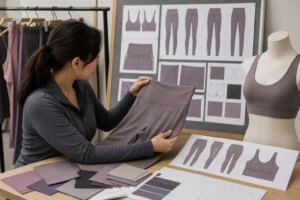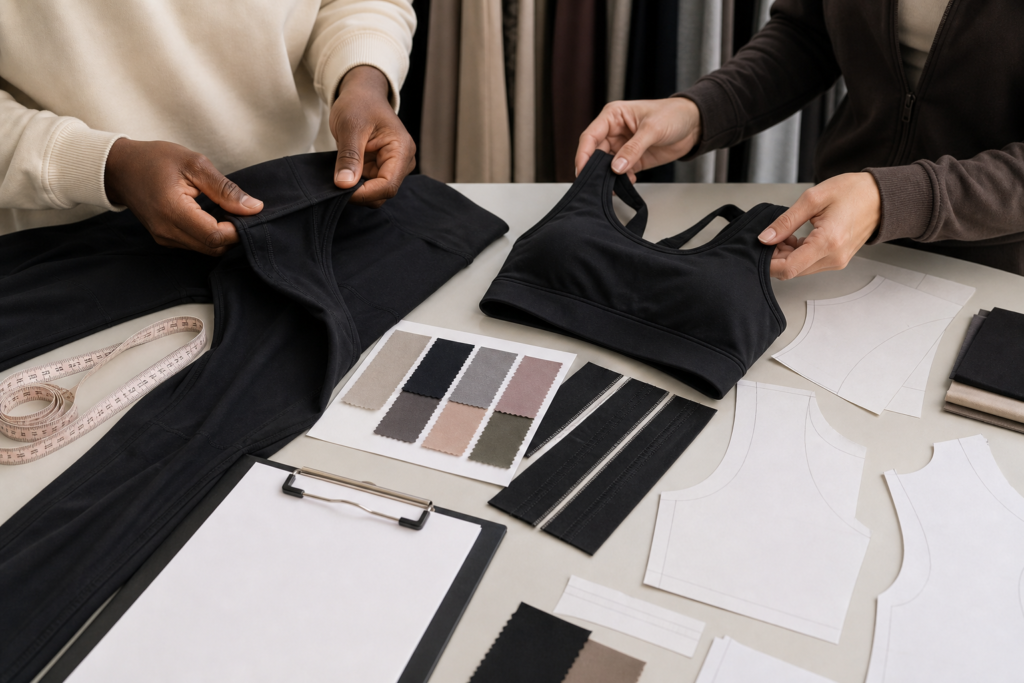
For B2B buyers comparing an activewear pattern maker vs manufacturer, the practical difference is coordination. An independent pattern maker develops technical pattern assets and may support fit revisions or grading. A full-service activewear manufacturer can connect pattern and sample work with sourcing, branding, production preparation, and shipment coordination. Neither route is automatically better: choose based on who on your team can own materials, fit decisions, sample revisions, and the factory handoff.
If your brand already manages suppliers and has a product-development lead who can control specifications across vendors, standalone support can be effective. If you want development decisions carried into manufacturing through one coordinated workflow, an integrated partner may be a better fit. Ninghow Yoga’s pattern and sample development support is designed around that continuity, while the buyer remains responsible for approving measurements, materials, branding, and final production readiness.
Activewear Pattern Maker vs Full-Service Manufacturer: The Short Answer
| Route | Best fit when | Brand’s main responsibility | Coordination model |
|---|---|---|---|
| Independent pattern maker | You have an established factory, material sources, and internal technical ownership. | Coordinate sourcing, samples, approvals, testing requirements, and production handoff. | Several specialist vendors managed by the brand. |
| Full-service activewear manufacturer | You want pattern and sample decisions connected to sourcing and bulk-production preparation. | Provide controlled specifications and approve each decision gate. | One manufacturing partner coordinates more of the connected workflow. |
Quick decision rule: Select standalone pattern making when your team can confidently manage cross-vendor information and sample-to-bulk control. Consider full package apparel manufacturing when reducing fragmented handoffs is more valuable than separating each development function. Fewer handoffs do not mean fewer buyer decisions; they mean those decisions can be documented and carried forward in one system.
What Each Development Route Typically Covers
An independent pattern maker is a distinct apparel-development specialist. Patternmakers create and refine garment patterns, a role separate from factory production responsibilities.1 Scope commonly includes technical pattern creation, fit-related changes, and grading where agreed. The brand should confirm whether deliverables include digital pattern files, a measurement chart, grading rules, marker support, or only a base-size pattern.
An apparel sample maker may create a prototype or fit sample from the approved pattern. Before that work begins, the buyer needs to confirm the material or acceptable substitute, construction details, seam type, elastic or trim requirements, artwork placement, and sample purpose. A prototype that checks silhouette is not necessarily a fit sample, and a fit sample is not automatically suitable for production approval.
A full-service manufacturer may combine pattern and sample development with fabric and trim sourcing, labels, hangtags, packaging, quality planning, bulk-production preparation, and shipment coordination. Exact services remain agreement-specific. For example, material sourcing must connect to the garment format, intended activity, color, construction, trims, and branding—not be treated as an isolated fabric-name selection. Likewise, development work does not remove the need for feasibility review and staged sampling.
For brands seeking a broader concept-to-production route, ODM activewear development can help organize development inputs. Regardless of route, document the agreed scope before work starts so development services are not confused with production execution.
Who Owns the Handoffs, Materials, and Production Information?
The key operational question is not simply who makes the pattern. It is who controls the current, approved product definition when that pattern reaches the factory. That definition normally includes the tech pack, pattern files, point-of-measure chart, grade rules, material references, trim details, artwork, labels, packaging notes, sample comments, and revision history.
| Workstream | Buyer / brand | Independent pattern maker route | Integrated manufacturer route |
|---|---|---|---|
| Product brief and commercial intent | Defines target wearer, activity, fit priorities, brand requirements, and approval criteria. | Receives and interprets the brief for pattern work. | Receives the brief and aligns development inputs with manufacturing feasibility. |
| Pattern and grading | Approves measurements, fit direction, and ownership terms. | Creates or revises assets as agreed; brand transfers approved files to factory. | Coordinates pattern development and measurement review before production preparation. |
| Fabric, trims, and color | Sets requirements and approves submitted options or references. | Usually coordinates suppliers and factory separately. | Can coordinate sourcing with construction and branding requirements. |
| Sample comments and changes | Provides consolidated, dated approval or revision comments. | Manages communication between sample maker, pattern maker, and factory. | Approves controlled changes while the manufacturer coordinates internal handoffs. |
| Bulk handoff | Approves final controlled version and PP sample. | Confirms the factory received all current files and exceptions. | Connects approved development records to bulk-production preparation. |
Use formal version control rather than relying on email threads, screenshots, or unmarked sample photos. A revised waistband height, logo position, or fabric substitution can affect fit, cost, construction, and production instructions.
Illustrative revision-control template:
| Version | Revision date | Controlled change | Impact to review | Approval status |
|---|---|---|---|---|
| V1.0 | YYYY-MM-DD | Initial legging measurement chart and construction brief | Base pattern and first fit sample | Pending buyer approval |
| V1.1 | YYYY-MM-DD | Adjusted waistband construction and front-rise measurement | Pattern, sample, and fit review | Approved / revise / rejected |
| V2.0 | YYYY-MM-DD | Approved PP specification; list any controlled exceptions | Bulk material release and production instructions | Approved for bulk |

Decision Criteria for Activewear and Yoga Apparel Brands
Choose a route based on workload and control requirements, not on the label “independent” or “full service.” Use these four questions as a decision framework:
- Technical capacity: Can your team assess stretch direction, recovery, opacity expectations, seam placement, support, fit, and grading feedback? Performance requirements should be specified and evaluated for the actual garment; they should not be assumed from a fabric composition or weight.
- Supply-chain readiness: Who will source or approve fabrics, elastics, trims, colors, labels, and packaging? If fabric options are still open, identify the intended activity and construction before comparing materials.
- Production continuity: Can you ensure the approved pattern, sample comments, and material selections reach the production factory without uncontrolled changes? This is often the central risk of a multi-vendor route.
- Collection complexity: Are you developing several coordinated pieces, multiple size ranges, or a set with shared visual standards? A bra-and-legging set needs coordinated shade matching, logo placement, and size logic, but each garment still needs its own specification. Do not assume one bra-and-legging size combination fits every customer; define separate or fixed size options.
Choose standalone support when you answer “yes” to all four questions internally. Choose an integrated activewear product development partner when your team needs help connecting the answers into a controlled production handoff.
When a Standalone Pattern Maker May Be the Better Fit
A standalone pattern maker may be the right choice for an experienced brand with an established factory, approved material suppliers, and an internal product-development owner. It can also suit a team that wants specialist pattern support before selecting a production partner or that needs to keep development and production vendors separate for business reasons.
Before engaging pattern making services, confirm these points in writing:
- Base-size, grading, and file-format deliverables
- Pattern ownership and permitted factory use
- Number and purpose of revision rounds
- Whether the provider makes samples or coordinates an apparel sample maker
- Who supplies and approves fabrics, elastics, trims, and color references
- Who checks sample-to-bulk consistency, testing requirements, and production feasibility
- Who transfers the final approved package to the selected factory
This route is not necessarily simpler. It shifts more cross-vendor management to the buyer. It works best when the brand can consolidate feedback, maintain a controlled master file, and prevent a factory from using an outdated pattern or unapproved material substitution.
When a Full-Service Activewear Manufacturer May Fit Better
A full-service activewear manufacturer may fit brands that want one partner to connect pattern work, samples, sourcing, branding, and bulk-production preparation. The advantage is continuity: sample findings about seam placement, fabric behavior, label placement, or packaging can be carried into the manufacturing instructions rather than re-explained to separate vendors.
At Ninghow Yoga, supported development scope includes pattern development, sample coordination, measurement review, and fit communication before bulk production. Fabric and trim sourcing can be coordinated with garment construction and brand requirements, while private-label preparation can include labels, hangtags, colors, branding, packaging, and collection presentation. Buyers can review fabric and trim sourcing requirements as part of this connected process.
Integration is valuable only if it improves specification control. The buyer must still approve measurements, material references, samples, labels, packaging, and any controlled changes. For private-label work, approval of the product and materials remains essential before manufacturing proceeds.
Specification Brief: What Buyers Should Prepare Before They Start
A clear brief gives both routes a workable starting point and produces a more meaningful quotation and development plan. Use this buyer preparation checklist for a legging, sports bra, or coordinated set request.
Buyer preparation checklist
- Product: garment type, target wearer, intended activity, silhouette, support level, coverage level, and size range
- Design: reference images, front/back/side views where available, color direction, panel lines, pockets, seam preferences, waistband construction, and fit priorities
- Materials: preferred fabric type or hand feel, stretch direction, recovery expectations, opacity expectations, moisture-management requirements, lining, elastic, trims, and acceptable alternatives
- Measurements: base size, point-of-measure targets, measurement method, tolerances, and grading expectations
- Branding: logo artwork in usable format, placement, decoration method preference, care label content, size label, hangtag, and packaging expectations
- Development control: sample purpose, required sample stages, revision limits, test or inspection needs, approval criteria, and final approver
Illustrative measurement-chart field structure:
| Point of measure | Measurement method | Base size | Tolerance | Approval status |
|---|---|---|---|---|
| Waistband width | Measure flat at top edge; method to be defined | Buyer-specified | Buyer/factory-agreed | Pending / approved |
| Inseam | Measure from crotch seam to hem; method to be defined | Buyer-specified | Buyer/factory-agreed | Pending / approved |
| Chest width | Measure flat at defined location; method to be defined | Buyer-specified | Buyer/factory-agreed | Pending / approved |
For coordinated collections, consider custom yoga apparel sets as a collection-planning reference, but maintain separate measurement and construction pages for every style.
From Pattern to Pre-Production Sample to Bulk Handoff
The following is a practical, labeled workflow for a coordinated manufacturer-led route. Activities may vary by project, but bulk work should follow controlled approvals rather than visual assumptions.
- Buyer brief and feasibility review: Confirm garment intent, reference materials, measurements, branding, and sample purpose.
- Pattern and initial sample: Create or review the pattern, then assess construction, measurements, fit, and initial material direction.
- Material and branding confirmation: Confirm bulk-intended fabric, trims, color, decoration, labels, and packaging requirements.
- Pre-production (PP) sample approval: Review the full production standard before bulk material release.
- Bulk handoff: Release only the approved version, including controlled exceptions, to production planning and quality documentation.
The PP sample should represent the approved bulk fabric, trims, color, construction, logo, labels, measurements, packaging, and workmanship—or clearly list controlled exceptions. A sample that looks right in photos is not enough if fit, material, or workmanship differs from the intended bulk standard. Capture buyer comments in the controlled revision record, then confirm that the PP approval is the version used for production preparation.
For a project-specific discussion of how these handoffs apply to your collection, request a manufacturing consultation.
FAQ
Can an activewear manufacturer work from patterns made by an independent pattern maker?
Yes, if the manufacturer agrees to review and use the files. Provide the current pattern version, measurement chart, grading rules, construction notes, material and trim specifications, and written approval history. The manufacturer should still conduct a feasibility review and may need a sample before bulk production.
What should I provide to an apparel sample maker before requesting a sample?
Provide a clear brief: garment type, reference images, target measurements, size range, fabric and trim direction, construction details, branding, sample purpose, and approval criteria. State whether supplied materials are final production materials or temporary development substitutes.
Do I need a tech pack before hiring an activewear pattern maker?
A complete tech pack is helpful but not always required to begin. At minimum, provide a structured brief with design references, target measurements, construction expectations, and fit priorities. Agree on who will turn those inputs into the controlled technical specification.
What should be approved before moving an activewear sample into bulk production?
Approve the PP sample or controlled equivalent: bulk fabric and trims, color, construction, logo, labels, measurements, packaging, workmanship, and any documented exceptions. Resolve critical differences before bulk material release.